

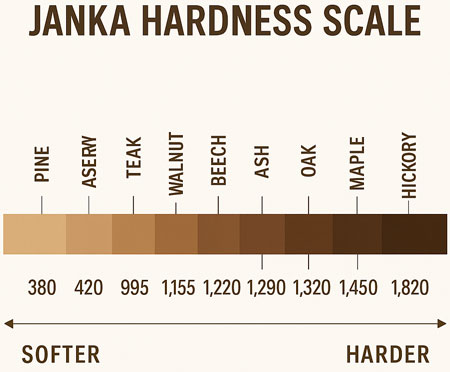
If you've started shopping for hardwood flooring, you've probably come across the term "Janka Hardness Scale." While it may sound technical, it's actually a simple way to compare how resistant different wood species are to dents and everyday wear. At Plaza Carpets, we welcome homeowners to our Lexington showroom to explore a wide variety of hardwood flooring options and receive expert guidance on choosing the right floor for their lifestyle. Understanding the Janka Scale can help you select flooring that not only looks beautiful but also stands up to the demands of your home.
What is the Janka hardness scale?
The Janka Hardness Scale measures the force required to embed a 0.444-inch steel ball halfway into a piece of wood. The resulting number represents how resistant that wood species is to dents and wear.
A higher Janka rating generally means the wood is harder and more resistant to everyday impacts, while a lower rating indicates a softer wood that may show dents more easily.
It is important to remember that the Janka Scale measures hardness only. It does not evaluate water resistance, scratch resistance, finish durability, or overall flooring quality.
Why does the Janka rating matter?
The Janka rating gives homeowners a helpful reference point when comparing hardwood species. If your home experiences heavy foot traffic, active children, or large pets, selecting a harder wood can help your floors maintain their appearance for years.
However, the hardest wood is not automatically the best choice for every household. Your home's style, budget, maintenance preferences, and overall design goals should all play a role in your decision.
For a closer look at available products, browse our hardwood flooring collection.
Common hardwood species and their Janka ratings
Here are several popular hardwood species and their approximate Janka hardness ratings:
- Eastern White Pine: 380
- American Cherry: 950
- Black Walnut: 1,010
- Red Oak: 1,290
- White Oak: 1,360
- Hard Maple: 1,450
- Hickory: 1,820
These numbers provide a useful comparison, but remember that many engineered hardwood products use these same wood species as their wear layer, allowing homeowners to enjoy both durability and design flexibility.
Hardness is not the only factor
Many homeowners assume that choosing the highest Janka rating guarantees the best flooring, but several other considerations are equally important.
These include:
- The quality of the factory finish
- The thickness of the hardwood wear layer
- Proper installation techniques
- Indoor humidity control
- Routine maintenance and cleaning
A well-installed hardwood floor with a durable finish often performs better over time than a harder wood that is improperly installed or poorly maintained.
If you'd like to learn more about hardwood construction, installation, and care, visit our hardwood flooring information page.
Matching hardwood to your lifestyle
Rather than focusing solely on hardness numbers, think about how each room is used.
For example, bedrooms typically experience lighter foot traffic than entryways or kitchens. Families with energetic children or large dogs often benefit from harder wood species, while homeowners looking for rich character and natural patina may prefer a slightly softer species that develops personality over time.
Choosing the right hardwood is about balancing durability with appearance, comfort, and your overall design vision.
Should you always choose the hardest wood?
Not necessarily.
Extremely hard wood species can sometimes be more difficult to cut and install, and they may come with a higher price tag. Many homeowners find that mid-range options like White Oak or Hard Maple provide an excellent combination of beauty, durability, and long-term value.
Speaking with flooring professionals allows you to compare samples, finishes, and species side by side so you can make the best decision for your home.
Frequently asked questions
Is a higher Janka rating always better?
Not always. Higher ratings offer greater dent resistance, but the ideal hardwood depends on your home's needs, design preferences, and budget.
Does the Janka Scale measure scratch resistance?
No. The Janka test measures dent resistance. Scratch resistance depends largely on the flooring finish and everyday care.
What is considered a good Janka rating for a home?
Many popular hardwood species between 1,200 and 1,500 on the Janka Scale provide an excellent balance of durability and natural beauty for residential use.
Does engineered hardwood have a Janka rating?
Yes. The Janka rating is based on the hardwood wear layer species, not the flooring construction itself.
Find the right hardwood with expert guidance
Whether you're comparing wood species or exploring the latest hardwood styles, the team at Plaza Carpets is here to help. Visit our Lexington showroom to see hardwood samples in person, or contact us to speak with our flooring experts and begin planning your next flooring project.


